ProjectsRobotics & Experimental Systems
NocturneTag
Research into gateway-free, disruption-tolerant LoRa communication between identical battery-powered tags. A concept with a written development and research plan; the first milestone, a two-board LoRa bench test, has not yet run.
- 868 MHz LoRa · SX1262 radio
- nRF52840 + Zephyr (planned)
- Milestone 0 bench test pending
Evidence ledger
Every claim carries the strongest evidence that currently exists for it. Planned work is listed as planned.
- PlannedM0 · Radio bring-up: two boards each send 30 sequence-numbered packets to the other under a documented SRD profile, logging sequence, RSSI, SNR, modem settings and computed airtime. Representative TX, RX and sleep currents are measured for the energy baseline. A build alone does not count as passing.
- PlannedM1 · Durable three-node mesh (source, relay, destination): bounded non-volatile outbox and relay store, deduplication persisted before an authenticated destination receipt, expiry that survives resets. Tested by switching the relay off, rebooting the source and restoring the relay.
- PlannedM2 · Test of the research hypothesis on five nodes: discovery-first, conditional urgent-first and unconditional urgent-first treatments compared under the same energy and airtime budgets, with contacts replayed across policies.
- PlannedProvisional engineering target of 95 % urgent delivery within 60 seconds over two connected hops. This is a target for the system, kept separate from the research result, which is the comparison against the strongest matched control.
- PlannedM3 · Field evidence on a repeatable farm scenario and a separate outage drill, followed by an FPGA decision based on measured receive-window uncertainty and whole-node energy.
Key: Planned
Research question
Put plainly: after a network has been split, two devices may be in radio contact for only a short time. A normal exchange spends the first transmission on discovery (“who is there, what do you hold?”) and sends data afterwards. If the contact ends early, the urgent message never leaves. The alternative is to spend that first scarce transmission on the urgent message itself. The question is whether that choice improves delivery by the deadline without costing more energy or radio airtime, and under which contact durations it pays off.
Motivation
NocturneTag asks what a small, low-power wireless device can still do when there is no gateway, no repeater, no mains power, no internet and no cellular coverage. The plan starts from a concrete case that can be rehearsed repeatedly: a low tank level or a pump-pressure alert on a farm, crossing a terrain obstruction. A second, separate outage drill starts from cold boot with infrastructure unavailable, a failed relay, and two groups of tags reunited by a mobile tag. In both cases the interesting outputs are how much the network delivered, how long it took and how much energy it consumed.
Engineering challenge
Identical tags must originate, receive, persist and forward short messages, entirely on their own. That combines several constraints that pull against each other:
- Intermittent connectivity. Contacts are brief, arrive at unpredictable times and may end before a conversation completes.
- Durable storage and forwarding. A message that cannot be delivered now must survive resets and power loss, expire at a well-defined time, and never be silently renewed by a reboot.
- Radio airtime. Every discovery frame, retry, receipt and relayed copy consumes a limited transmit allowance.
- Energy. Listening costs as much as sending, so wake scheduling decides how many contacts are noticed at all.
- Deadlines. An alert that arrives after its deadline is of little use, however reliable the network is.
The trade-off under test
Discovery-first communication is robust and well understood, but it commits the first transmission to metadata. Urgent-message-first communication commits it to payload, which can only help if the frame is short enough, the message is eligible and the airtime budget allows it. A simplified, loss-free timing model from the research plan shows why contact duration matters. Let W be the delay from the start of radio contact to the first receivable transmission, D the airtime of the complete alert frame, and H the additional control exchange and scheduling delay a discovery-first sender needs before it can start that alert. For a contact of length C, the interesting range is W + D <= C < W + H + D. Below this range both approaches miss the contact; above it both may succeed. The model predicts a crossover, not a guarantee. Real experiments must measure reception, persistence of the alert, half-duplex conflicts, preamble effects and the available transmit airtime, and a longer first frame can remove the advantage or make it worse under collisions.
Technical approach
The first policy to test keeps a common minimum asynchronous discovery and receive schedule on every peer, independent of queue contents, with one fixed RF profile, a fixed preamble and a bounded number of relay transmissions. At a transmission opportunity, a peer sends its normal discovery frame unless an urgent message would miss its deadline by waiting for the next planned discovery. In that case one alert frame replaces the discovery frame. Attempts are debited before transmission, capped per message and per node, and counted with their complete airtime. Destination receipts and deduplication are identical in every treatment, and a relay copy never counts as delivery to the final destination.
The comparison is deliberately strict. Four treatments run on the same firmware and RF profile: discovery-first against conditional urgent-first frame selection, each with fixed or adaptive receive scheduling, plus an unconditional urgent-first control and a tuned discovery-first bounded-replication control at the same budgets. The frame-order comparison is isolated with identical fixed receive settings first. The primary comparison, workload and caps are to be declared before the measurements.
Architecture
Local access
- BLEcommissioning · message access
- Serial interfacefirst, before BLE
Policy
- Deadline-aware policyurgent-first vs discovery-first
- Energy and airtime budgets
Durable state
- Outbox and relay storebounded · non-volatile
- Deduplication and expirysurvives resets
Radio
- LoRa, 868 MHzSX1262 · peer to peer
- nRF52840 hostZephyr
Dashed blocks are local access paths; the mesh itself runs without a phone. Frame encoding, queue policy and expiry logic are intended to be testable on a host, independent of the radio.
Planned implementation
Work is staged so that each step produces evidence before the next begins. M0 brings up the radio link between two boards and records a clean-bench baseline. M1 builds a durable three-node mesh, with a negative control in which the relay stays offline. M2 tests the hypothesis on five nodes with replayed contact traces. M3 repeats the work in the field and uses measured radio duty cycling and timing as the basis for deciding whether FPGA fabric is justified at all. The existing PolarFire hardware would be used only to test hardware timestamps and wake scheduling if shorter receive windows could save meaningful energy.
Limitations
Radiated tests must respect the applicable German SRD allocation, including its airtime limits. The exact radio module, antenna and pin assignments are still to be confirmed against the hardware on the bench.
Next steps
Implement M0 only: pin the Zephyr version, configure the nRF52840 DK and the second board, document the radio module’s wiring and settings, and run the 30-packet exchange in both directions with raw serial captures committed alongside the firmware revision. Over-the-air results stay marked pending until the physical boards have run.
Media
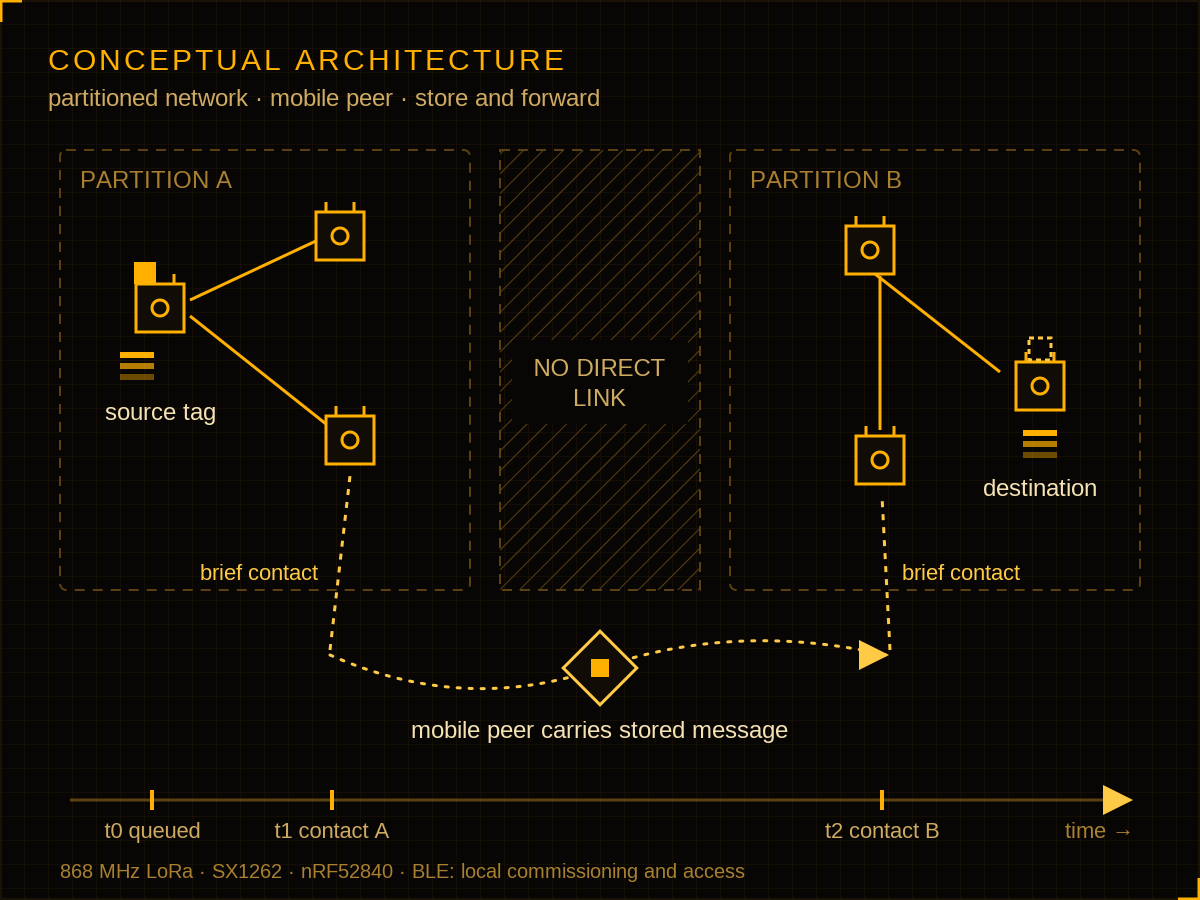
diagram · Conceptual architecture. A partitioned network, a mobile peer, and a message that is stored, carried and delivered later. Illustration of the design concept; not a measurement or a deployment.