ProjectsRobotics & Experimental Systems
Robi
A low-cost educational robot concept for introducing children to robotics and technology through a friendly face, a voice interaction and affordable, openable parts. Design and firmware prototypes exist; no physical robot has been built.
- Teaching robotics to children
- Common off-the-shelf parts
- CAD and firmware prototypes; no build yet
Evidence ledger
Every claim carries the strongest evidence that currently exists for it. Planned work is listed as planned.
- Synthesized / implementedHead firmware for an M5StickC Plus builds with a pinned PlatformIO toolchain: animated eyes, a local Wi-Fi control page, and a push-to-talk voice echo played through the speaker HAT. The speaker build uses 78.8 % of the application partition.
- SimulatedFirst parametric Fusion assembly (millimetres, every component size an adjustable assumption). Its interference review found real overlaps between the body shell and the motor-driver module (736 mm³) and the two motor shafts (59 mm³ each), and flagged that the face opening is far larger than the display it must frame.
- PlannedMeasure the real chassis, motors, wheels, battery and driver module, then correct the CAD, mounting points and openings for the microphone, speaker and charging connector.
- PlannedConnect the head to the motor controller over a defined link. Any movement command must carry a timeout that stops both motors if communication is lost.
- PlannedBuild a physical prototype, assess it for safety with children (small parts, battery, motors), and only then try it with children and revise it.
Key: Synthesized / implemented · Simulated · Planned
Why Robi
Robi is about making robotics approachable for children. It is not meant to be a high-end research robot. The idea is a small, friendly robot that a child can talk to, watch and eventually look inside, built from low-cost parts so that the technology feels understandable rather than magical. The aim is to explore how robotics can be taught to children in an up-to-date, intuitive and affordable way.
Engineering challenge
A robot for children has to be inviting and robust at the same time, and it has to stay cheap enough to build more than one. That sets tight limits on the parts, on how complicated the electronics can be, and on how much anyone has to learn before it does something delightful. The challenge is to keep every layer simple enough to explain: a face that shows what the robot is doing, a button that starts it listening, a voice that answers, and a body that can later move.
Approach
Robi starts from ordinary, widely available hardware instead of custom boards. An M5StickC Plus is the head: its small display draws the animated eyes, its microphone listens, and its Wi-Fi hosts a simple control page for a phone. A speaker HAT gives it a voice. The body is intended to reuse an existing two-wheel robot platform with an Arduino Uno, an H-bridge motor driver and a rechargeable battery, so that the first robot does not require a new chassis.
Interaction is deliberately small. The front button on the head is push-to-talk: press and hold to record up to five seconds, release to hear it played back, with the eyes showing which of the two is happening. The same robot can change expression from a phone, and tilting it makes the eyes follow. Each of these is a first, tangible experience that a child can try with no instructions.
Architecture
Interaction
- Animated eyeson the head display
- Push-to-talk buttonrecord, then play back
- Speaker HATPAM8303
Head
- M5StickC Plusdisplay · microphone · Wi-Fi
- Local control pagefrom a phone, no internet
Body (planned)
- Arduino Uno + H-bridgelink to head not yet defined
- Two geared DC motorsexisting chassis
- Rechargeable battery
Dashed blocks are interaction elements. The body blocks are planned and not yet wired to the head.
What exists today
- Head firmware. A PlatformIO project for the M5StickC Plus draws the animated face, runs its own Wi-Fi access point with a phone control page, and implements push-to-talk recording and playback through the speaker HAT, with the eyes animated differently while recording and while playing. It builds. Only the voice playback has been heard on the device, informally, while its volume was tuned by ear; the face, the Wi-Fi page and the tilt response have not been confirmed on hardware in any documented test, and no recordings or measurements exist.
- CAD. A first parametric Fusion assembly places a rounded two-part shell over the chassis, the Uno, the motor driver, the battery and the head electronics. The head lifts off and the electronics slide out for service. Every component size in it is an assumption that has not been measured.
Where a child could start
These are the experiences the current prototype already supports, listed as starting points rather than a curriculum: press the button and hear your own voice come back; change the robot’s expression from a phone; tilt it and watch the eyes follow (the tilt direction is not yet checked on the device); and, once the body is connected, make it drive. Whether these work for children is untested.
Limitations
The link between the head and the motor controller is undefined, and no motor code or pin assignment exists. The cost goal has not been checked against a priced parts list.
Next steps
Measure the real chassis and components, correct the CAD and add the microphone, speaker and charging openings. Define the head-to-motor-controller link with a mandatory stop-on-silence timeout, wire it up on the bench with the wheels lifted, and then build a first physical prototype. Safety review and trials with children come after that, not before. The earlier Spartan-7 and ESP32 notes in the same repository belong to the Noxling concept and are not the Robi hardware.
Media
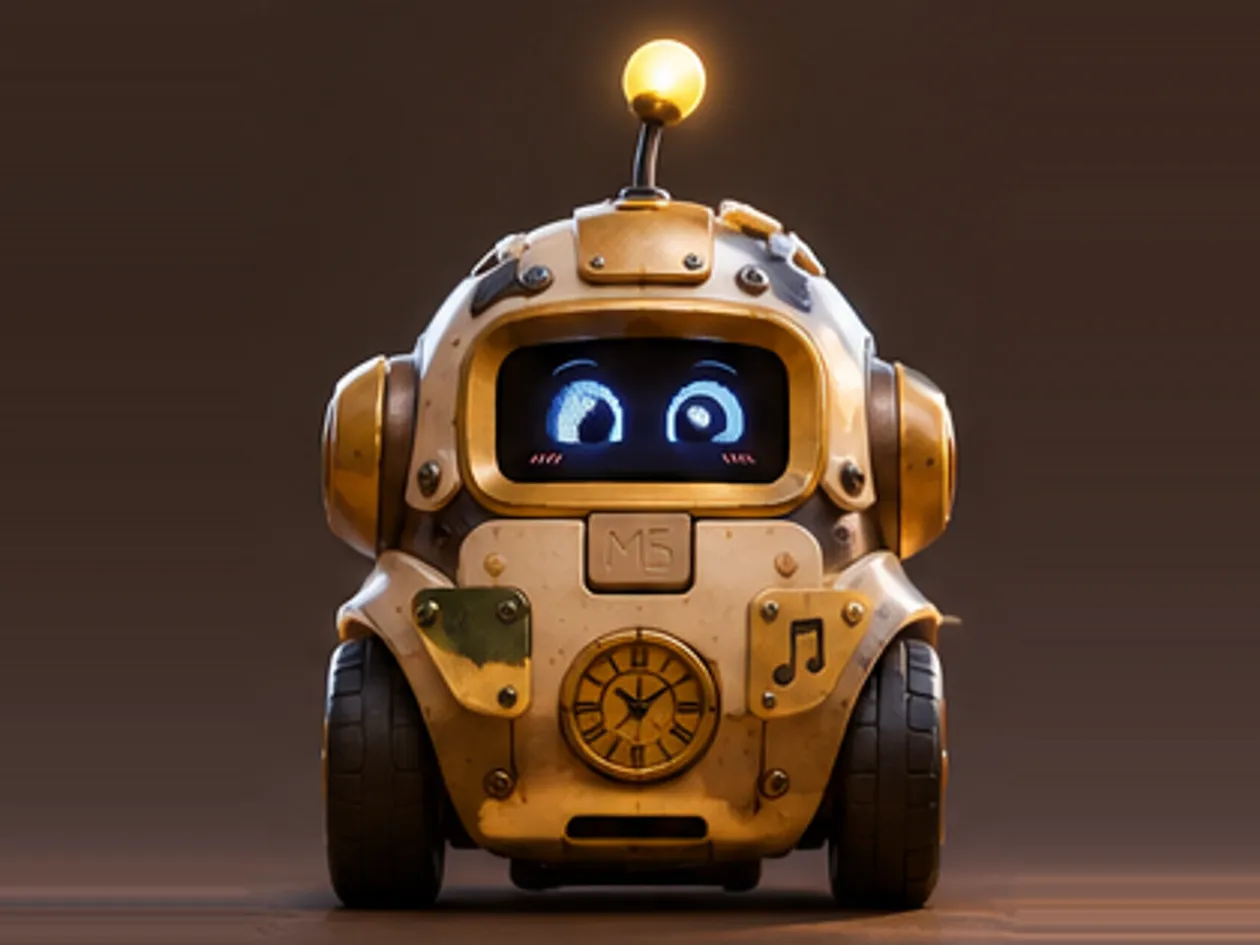
diagram · Early visual design study of the character the CAD is meant to realise: an AI-generated concept illustration, front view, cropped from a concept board. Not a photograph, and not a built robot. 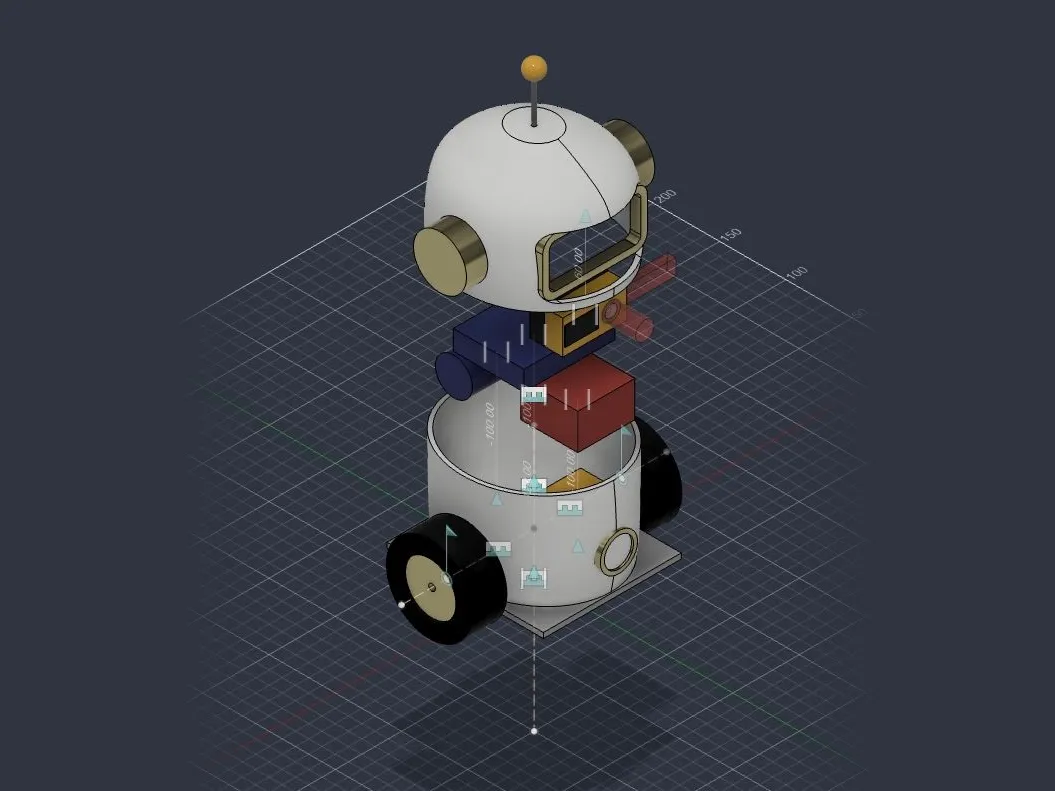
diagram · CAD concept render (Fusion), exploded service view: the head lifts off and the electronics slide out. Early design study with placeholder component volumes, not a photograph of a built robot. The image is extended with its own flat background to fit the frame. · Cruz Garcia, Fusion